

Ed Zajac's paper Computer-Made Perspective Movies as a Scientific and Communication Tool (1964) makes the point that the basic transformation needed to make a perspective drawing is mathematically trivial and, with the faster computers now available, could be generated at a reasonable cost.
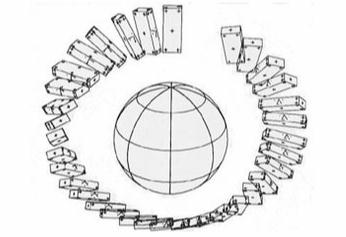
Early on it became clear that enhanced visualisation of 3D objects was possible via computer animation showing a sequence of different views of the objects. Michael Noll in his paper Computer Generated Three-Dimensional Movies (1965) noted that 3D presentations that require time as a fourth variable can be displayed as a two-dimensional perspective movie with monocular depth clues if made from two different viewpoints.
He also discussed the use of stereographics in his paper Stereographics Projections by Digital Computer .
Cyrus Levinthal, in his paper Molecular Model-building by Computer (1966) showed how a chemist could investigate the three-dimensional arrangement of the atoms.
Ruth Weiss at Bell Labs produced BE VISION A Package of IBM 7090 FORTRAN Programs to Draw Orthographic Views (1966) with hidden lines omitted.
Another problem that the faster computers could solve was the amount of structured data required to simulate a complex object and display it. Two papers early on were:
- Graphic Applications to Aerospace Structural Design Problems (1967)
- Computer Graphics Displays of Simulated Automobile Dynamics (1969)
Art Appel at IBM was a major developer of 3D computing and two papers Some techniques for shading machine renderings of solids and The Interactive Design of Three-Dimensional Animation are of interest.